
How to choose ski boots: flex, Mondopoint size and boot
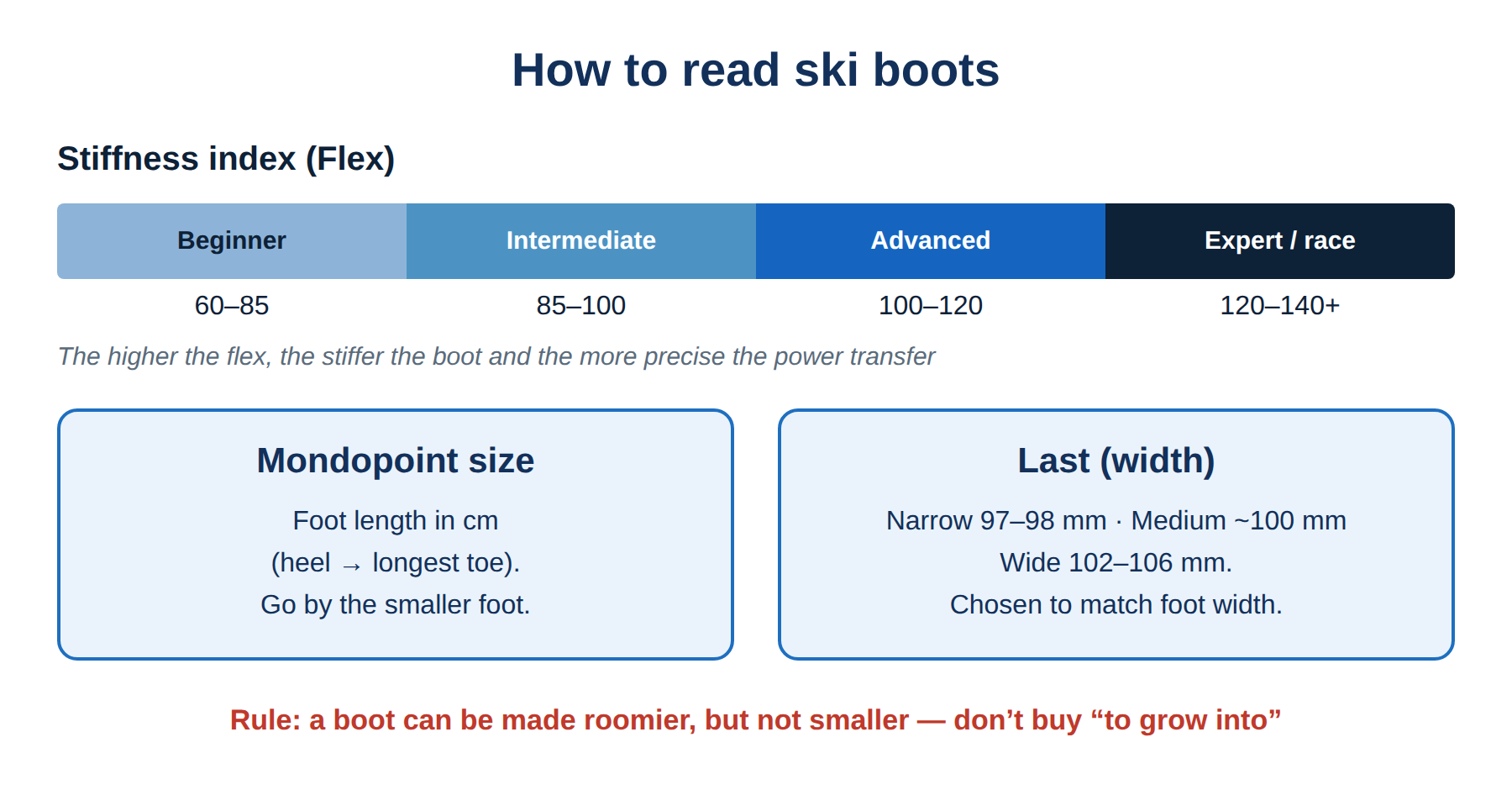
Experienced skiers know: skiing doesn’t start with skis, but with boots. They are the ones that transmit your every movement to the edge, hold your foot and are responsible for comfort throughout the day on the slope. Poorly selected boots can ruin even the best resort, while the right pair makes skiing precise and enjoyable. Let’s look at three key parameters that you should look at first.
Mondopoint size – foot length in centimeters
Ski boots are marked according to the international Mondopoint system, which corresponds to the length of the foot in centimeters. To determine your size, stand with your heel against a wall on a piece of paper and mark the longest toe – the distance in centimeters will be your Mondopoint value. Be sure to measure both feet: they are often slightly different, and you should focus on the larger one.
It is important to remember the main rule: over time, the boot can be made roomier (the lining “rolls out” and forms under the foot), but not smaller. Therefore, you should not take a size that is too large “for growth” – a boot that is too loose deprives you of control when skating.
Last – width of the shoe
The last, or last, is the width of the boot at the widest part of the foot. A narrow last is approximately 97–98 mm, a medium last is about 100 mm, and a wide last is 102–106 mm. Narrow models usually have less volume in the midfoot and heel, providing a tighter, more “sporty” fit. Wider last is more comfortable for full feet and long days of skiing. If you have a wide foot and the boot is squeezing on the sides, you probably need a wider last, not a different length.
Flex – stiffness index
Flex shows how stiff the boot is and how actively it transfers force to the ski. The higher the number, the stiffer the boot and the more precise the response. Recommended ranges: 60–85 for beginners, 85–100 for confident intermediate skiers, 100–120 for advanced skiers, and 120–140 and above for experts and athletes.
A stiff boot will only hinder a beginner: the foot will not be able to bend comfortably, and skiing will become tiring. An experienced skier, on the contrary, will appreciate stiffness – it provides instant response and control at speed. Also consider weight and height: a heavier skier usually needs a slightly stiffer flex.
Thermoforming and professional selection
Many modern boots (including the Atomic Hawx, Salomon, and Rossignol series) have thermoformable liners — they are heated and take the shape of your foot. This significantly increases comfort and fit. It is best to choose boots at the end of the day, when your foot is slightly swollen, in a thin ski sock, and do not be shy about consulting a boot fitter.
If you’re still unsure about your size or level, start with a rental. This allows you to try out different models and stiffness before investing in your own pair.
At Dzvin-Ski ski equipment centers , you can always rent equipment, have it checked by a master, and get advice before heading out on the slopes. Come in — we’ll be happy to help you choose the perfect set for you!
Subscribe to our social networks – Instagram and Facebook : there are new products, promotions and the life of our centers.