
Rocker, Camber and Flat: how ski profile affects skiing
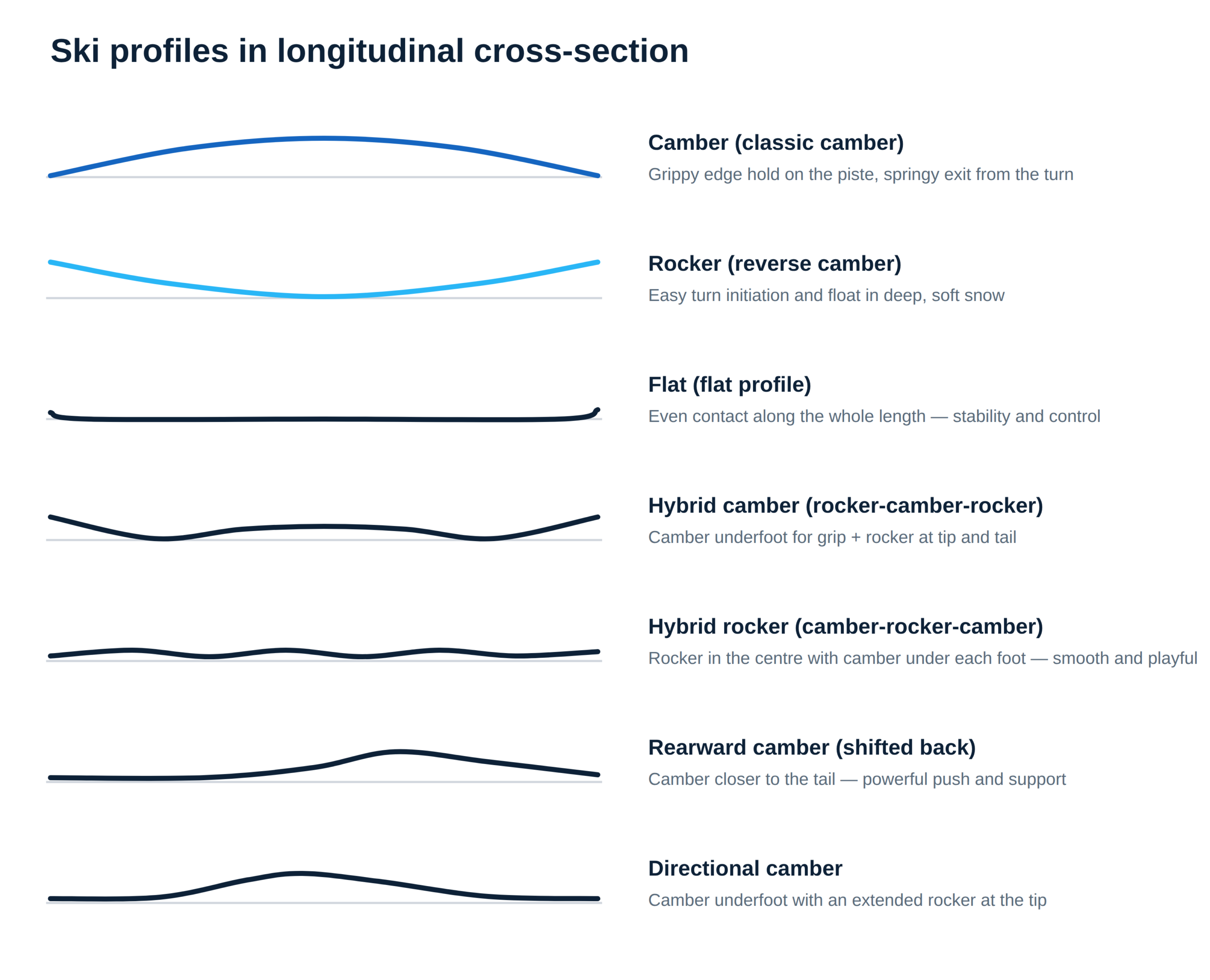
When choosing skis, most people look at the length, waist width, and brand. However, there is another parameter that radically changes the behavior of skis on the snow – their profile, that is, the shape of the longitudinal bend when viewed from the side. It is the profile that determines whether the ski will hold on to a hard trail, float easily in loose snow, or forgive mistakes for a beginner. Let’s look at the main types and their common combinations.
Camber – classic deflection
Camber is a traditional profile in which the unloaded ski is curved upwards in the middle and only touches the snow at the toe and heel. When the skier stands on it and transfers weight, this camber distributes pressure along the entire length of the edge. The result is a tight, precise grip on hard snow and groomed slopes, and an energetic, “springy” exit from turns. It is the best choice for carving and fast skiing on the slopes.
Rocker – reverse deflection
Rocker (also called reverse camber) works the other way around: the center of the ski rests on the snow, while the toe and heel are raised up, like the tips of a banana. This profile raises the toe off the surface, making the ski float beautifully in deep, loose snow and easy to turn. Rocker makes skiing more playful and forgiving of mistakes, although on hard trails it is inferior to camber in terms of edge grip accuracy.
Flat — flat profile
A flat profile is a neutral option where the ski lies flat on the snow along its entire length. It provides stability and predictability, serving as a compromise between the grip of camber and the float of rocker. These skis are often chosen by those who value smoothness and control without a pronounced character in one direction or another.
Hybrid (combined) profiles – the golden mean
Most modern all-mountain skis use hybrid profiles that combine camber, flat, and rocker in one design, rather than pure camber. This allows manufacturers to take advantage of the strengths of each solution: a firm grip underfoot while also providing easy turn entry and buoyancy. Below are the most common variations.
Hybrid camber (rocker–camber–rocker)
Camber underfoot provides edge grip, spring and control, while rocker in the toe and heel makes it easier to turn and adds float in loose snow. This is the most versatile profile for “a little bit of everything” skiing.
Hybrid rocker (camber–rocker–camber)
Here it’s the other way around: rocker in the center, and small areas of camber under each foot. These skis hold up well on soft to medium snow, remain playful and forgiving, with almost no edge grip.
Rear camber (backseat)
The flex is shifted closer to the heel and the toe gets a longer rocker. This profile gives a powerful push on turn exit and reliable support for jumps, which is why it is loved in freestyle and park.
Directional camber (directional)
Camber underfoot is combined with an extended rocker in the toe. The ski is designed for riding mainly in one direction: confidently cutting the trail and easily “floating” the nose in deep snow. A popular choice for freeride and all-mountain.
How to choose a profile that suits your style
If you ride mostly on groomed trails and love speed and sharp turns, look for a pronounced camber. If you dream of freeride and deep snow, your choice is a rocker or a profile with a powerful rocker in the toe. For most fans who ride “a little bit of everything,” the best solution will be a universal combined profile. And the most reliable way to understand what suits you is to try different skis on rent before buying your own pair.
At Dzvin-Ski ski equipment centers , you can always rent equipment, have it checked by a master, and get advice before heading out on the slopes. Come in — we’ll be happy to help you choose the perfect set for you!